A shot worth taking: understanding the MMR vaccine and the return of measles
By Alexa Dreyfus March 2026
Edited by Aaron Johnson
Have you ever looked at your vaccination record and wondered what MMR stands for? The MMR vaccine protects against measles, mumps, and rubella and is typically given in two doses between the ages of 12 months and 12 years (Centers for Disease Control and Prevention [CDC], 2025). Because measles is considered one of the most contagious diseases humans face, the United States began a major push in the 1960s to develop a nationwide vaccination program to create an effective immunization (CDC, 2024).
In 1968, an improved measles vaccine was introduced and proved to be highly effective. In 1971, vaccines for measles, mumps, and rubella were combined into a single shot, creating the MMR vaccine (CDC, 2024). Vaccination efforts soon expanded globally, with the World Health Organization supporting immunization programs worldwide to reduce measles transmission and increase immunity (World Health Organization [WHO], n.d.). Due to these efforts, the United States declared measles eliminated in 2000, as shown in Figure 1 (CDC, 2024).
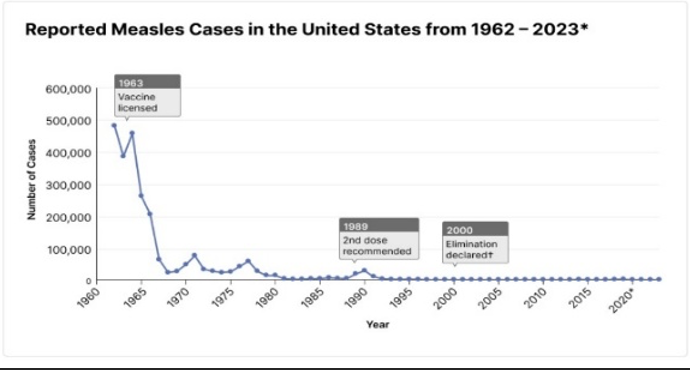
Figure 1. A graph showing the trend of reported measles cases in the United States from 1962-2023, from the CDC
So why are measles outbreaks appearing again in the United States? Over the past several months, more than 900 cases of measles have been reported (CDC, 2026). This outbreak has been linked in part to a trend among parents who choose not to vaccinate their children (Associated Press, 2025). For the measles vaccine to effectively protect a community, at least 95% of the population must be vaccinated (CDC, 2026). [MA1] When vaccination rates fall below this threshold, communities become vulnerable to outbreaks. Measles is very contagious, possibly leading to hospitalization and, in severe cases, death. While the outbreak has been most severe in Texas, it has spread to other states, particularly in areas with lower vaccination rates (Associated Press, 2025).
Changing attitudes in some parenting communities have contributed to growing distrust toward vaccines. Despite decades of scientific research and rigorous clinical trials conducted by scientists and medical professionals, misinformation persists. Some parents have been exposed to false claims linking vaccines to unrelated conditions, including disabilities (CDC, 2025). Scientists and public health experts have worked tirelessly to demonstrate that vaccines are safe and effective. However, public debate surrounding vaccination has led some parents to weigh perceived risks against the established benefits. Research suggests that many parents receive information about vaccines from biased media sources or misinformation, rather than from medical professionals (Shier et al., 2016). While vaccine hesitancy is a complex issue shaped by personal values, social environment, and access to reliable information, the scientific consensus remains clear: the MMR vaccine is safe and effective. For this reason, it is important for parents to build trusting relationships with pediatricians, who can provide accurate information about vaccines, explain their benefits, and address common misconceptions about safety (Shier et al., 2016).
“For the measles vaccine to effectively protect a community, at least 95% of the population must be vaccinated””
The ongoing measles outbreak is a reminder that diseases once nearly eliminated by vaccines can return when vaccination rates fall. Staying up to date on the MMR vaccine — which is 97% effective against measles with two doses — is one of the most reliable ways to protect yourself and the people around you (CDC, 2025). Checking your vaccination records and staying current on recommended immunizations helps protect not only yourself, but also your community. So remind your friends and family to check their records and talk to a doctor if they have questions about their vaccination status.
References
Associated Press. (2025). Measles outbreak in Texas, other states linked in part to unvaccinated communities. AP News. https://apnews.com/article/measles-outbreak-texas-rfk-new-mexico-kansas-vaccine-e904 ec9781f1d164c73afe4ab71774fe
Centers for Disease Control and Prevention. (2024). History of measles. https://www.cdc.gov/measles/about/history.html
Centers for Disease Control and Prevention. (2025). Measles vaccination. https://www.cdc.gov/measles/vaccines/index.html
Centers for Disease Control and Prevention. (2026). Measles cases and outbreaks. https://www.cdc.gov/measles/data-research/index.html
Shier, V., Ginsburg, M., & Howell, J. (2016). Achieving healthy vaccine coverage in children. PMC. https://pmc.ncbi.nlm.nih.gov/articles/PMC4869767/
World Health Organization. (n.d.). History of measles vaccination. https://www.who.int/news-room/spotlight/history-of-vaccination/history-of-measles-vaccination